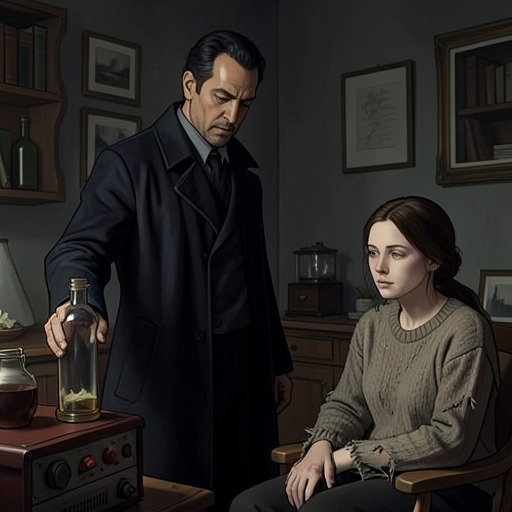
Rowan drinks vampire blood for the first time
The RadleysRowan Radley’s first drink of vampire blood turns a concealed temptation into a decisive break with abstinence. The bottle, given to him by Will Radley, has represented a choice Rowan has so far resisted. When distress at home prompts him to bring it out, Clara Radley drinks first; Rowan then takes his own drink, and the change he experiences is immediate. Relief from longstanding discomfort becomes exhilaration and, finally, levitation. The scene makes the blood’s appeal concrete while showing how quickly a moment of comfort can become a powerful personal turning point.
Causes and Background
Rowan’s approach to the bottle begins with hesitation rather than a settled decision. Earlier, he has sat on his bed holding it and wondering whether a very small taste could be kept under control. The question matters because the bottle is vampire blood and Rowan has not yet drunk from it. Its presence therefore holds two possibilities at once: a substance he has been taught to reject and a possible way out of a condition he finds difficult to bear.
The handbook beside him gives that conflict a wider context. Rowan consults The Abstainer’s Handbook and finds its note that suicidal depression is common among those who abstain. The passage does not itself diagnose him, but it connects his private distress to the costs of the discipline he is trying to maintain. The book’s stark principle that blood intensifies cravings also makes the apparent promise of relief uncertain. The scene sets these warnings against the increasingly attractive possibility of trying the bottle, without resolving the danger before Rowan acts.
His decision is also shaped by memories of being bullied at school. He recalls a recent incident in which Harper knocked him down while other boys, including Toby Felt, laughed. Rowan remembers that he did not want to fight back; he wanted to disappear from the situation altogether. That recollection brings a long-standing sense of vulnerability into the bedroom scene. His first drink follows not a triumph over an opponent but a wish to escape the humiliating powerlessness he associates with his ordinary life.
The Bottle and Clara’s Distress
Before drinking himself, Rowan brings the bottle out from beneath his bed while trying to comfort Clara. She is troubled by the family’s lies and by the consequences of her killing Stuart Harper. Rowan recognizes that his reassurance is not enough, so he shows her the bottle. He explains that Will Radley gave it to him and that he has not drunk any. The object he had concealed now becomes something he offers to his sister in a moment of shared family distress.
Clara accepts the bottle and drinks. Her immediate response is relief: the worry that had been visible in her expression is gone when she looks up again. She returns the bottle to Rowan and asks whether he will try it, presenting self-control as something that might be possible even after drinking. Her response offers him a direct example of the blood’s short-term emotional effect. It also changes the scene’s atmosphere: the bottle is no longer only a private temptation under Rowan’s bed but a substance his sister has already taken, with an apparently reassuring result.
The contrast between Clara’s relief and Rowan’s uncertainty does not make his choice inevitable. He still has the opportunity to refuse. But her experience, his own distress, and the memory of Harper’s bullying converge around the bottle. Rowan picks it up and drinks, making his first consumption a response to accumulated pressure rather than an isolated experiment detached from the rest of his life.
The First Drink and Its Effects
The change begins almost at once. Rowan feels his worries and tension recede, and the aches and ailments that have been familiar to him seem to disappear. Instead of simply returning to calm, he feels newly awake. The difference is presented as a sharp bodily and emotional reversal: the condition he has endured gives way to an energy he has not known before. The speed of that reversal is central to the event’s force, because it supplies immediate reinforcement for the choice he has just made.
Rowan then examines his reflection as the pink blotches and the grayness beneath his eyes vanish. The visible change gives him confirmation outside his own sensations: the relief appears on his face as well as within him. The scene moves from diminished anxiety to a more expansive sense of possibility. Above the bedside table, where The Abstainer’s Handbook lies, Rowan begins to levitate. The detail places the book’s rules beneath him at the moment when the experience seems to make ordinary limits, including gravity, breakable.
His laughter accompanies this transformation. Rowan understands himself differently: no longer as the ridiculous figure others have made him feel, but as someone with power and capacity. That surge of confidence is an effect of the first drink, not proof that its benefits are stable or harmless. The scene records the intoxicating promise of liberation while leaving the longer consequences of renewed drinking unresolved.
Consequences and Significance
This first consumption changes the bottle from a feared possibility into a source Rowan has personally experienced. Before drinking, he has weighed whether he could control even a small taste; afterward, he has felt immediate relief, physical renewal, and levitation. Those effects make abstinence harder to understand as a purely abstract rule. Blood has answered a real need in the moment, even as the handbook warns that it magnifies craving rather than satisfying it.
The event also links Rowan’s vulnerability to his new sense of power. His remembered humiliation helps explain why relief alone is not the whole attraction: the blood appears to reverse the weakness and ridicule that have shaped his self-image. The shift from despair to laughter therefore carries both release and risk. Rowan’s declaration to himself that he can do anything is the emotional climax of the scene, while the contrast with the handbook beneath him quietly preserves the question of what this freedom will cost.
Clara’s earlier drink and Rowan’s first one form a consequential sequence within the same family crisis. She receives immediate comfort, and he sees that response before making his own choice. But Rowan’s experience goes further: the blood alters his perception of his body and his possibilities. His first drink is thus a turning point in which private temptation, family distress, the shame of bullying, and the promise of extraordinary capability meet. The scene establishes why the blood is compelling to him without erasing the warnings that make the choice dangerous.